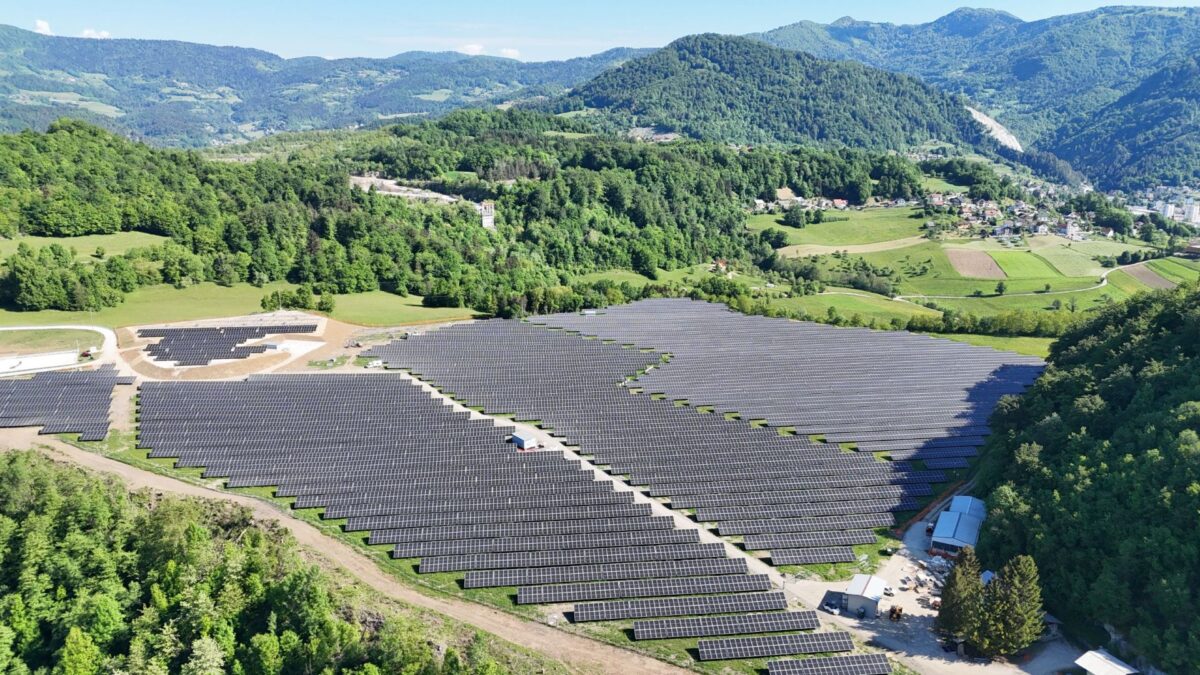
Roofs are the first choice, but for larger capacities land comes into play: disused landfills, quarries, land along infrastructure, lower-quality agricultural land. Since August 2023, building ground-mounted solar power plants in Slovenia has been governed by a dedicated act (ZUNPEOVE), which has simplified procedures considerably in some places — but only if you know where and how. In this guide we explain where such a plant is permitted at all, which approvals and permits you need, and a realistic project timeline.
Legal framework: ZUNPEOVE and the implementing decree
The Slovenian Act on the introduction of installations for generating electricity from renewable energy sources (ZUNPEOVE, Official Gazette of the RS No. 78/23 et seq.) governs the siting of photovoltaic and wind installations. It is supplemented by the Decree on more detailed spatial planning rules for siting photovoltaic installations and solar collectors (2024), which harmonised the conditions across the country; before that, they differed from municipality to municipality.
Designated priority areas (Article 8 of ZUNPEOVE)
In these areas, installing photovoltaic systems is made easier, in some cases regardless of the provisions of spatial planning acts:
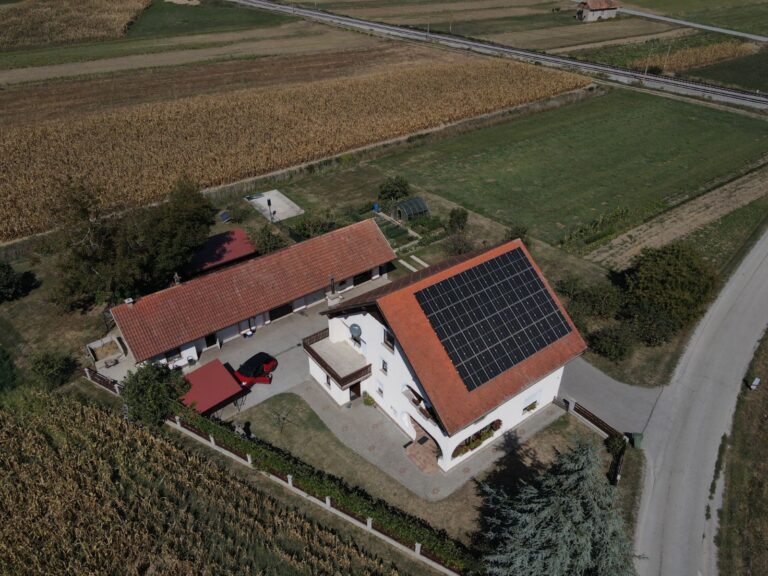
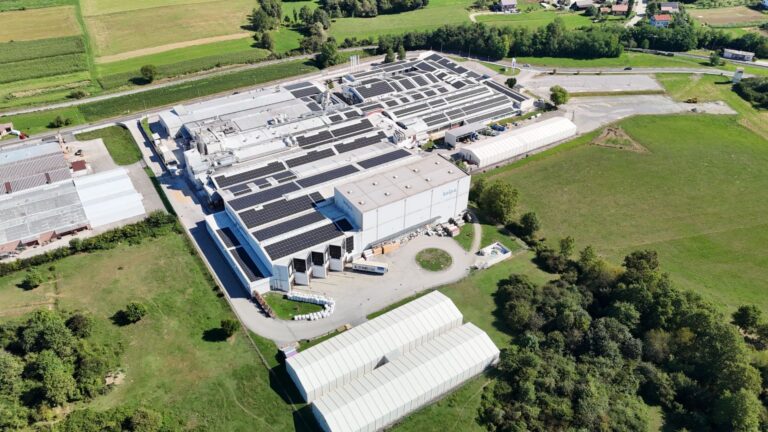
- roofs of existing buildings with a footprint of more than 1,000 m²;
- paved car parks on building land larger than 1,000 m²;
- road and railway land (e.g. noise barriers, embankments);
- areas of electricity generating facilities and substations;
- existing inactive and closed landfills;
- degraded areas and abandoned pits.
For new buildings, the act in some cases even requires a solar power plant: new buildings with a roof larger than 1,000 m² and new car parks larger than 1,000 m² must be equipped with a photovoltaic installation, otherwise the investor will not obtain a building permit.
Agricultural land
The best agricultural land is not available for conventional ground-mounted solar power plants; on lower-quality agricultural land (land becoming overgrown, permanent grassland below a certain quality rating), options are opening up through changes to agricultural legislation and agrivoltaics — more in our blog post on agrivoltaics. In each specific case, the land use designated in the municipal spatial plan (OPN) and the position of the competent spatial planning authorities are decisive.
Which approvals and permits do you need?
- Check of spatial planning acts (OPN/OPPN): land use, protection regimes (Natura 2000, cultural heritage, water protection areas, flood areas).
- RES study (elaborat OVE): for siting in some designated priority areas, a study is prepared and published, and the public and the municipality submit comments on it (the procedure is run by the Ministry of the Environment, Climate and Energy, MOPE).
- Grid connection approval from the distribution system operator or, for larger capacities, ELES conditions: the key bottleneck — check the grid capacity at the site before buying or leasing the land.
- Building permit: generally required for ground-mounted solar power plants (exceptions for certain installations in priority areas are set out in ZUNPEOVE and the decree); amendments to construction legislation have introduced simplifications for RES.
- Opinions of the spatial planning authorities: agriculture, water, nature, cultural heritage, roads/railways, depending on the site.
- Contractual arrangement for the land: purchase, building right or long-term lease (generally 25–30 years), registered in the land register.
A realistic project timeline
(Indicative values from JB energija’s practice for 0.5–5 MW power plants; every project is different.)
- Months 1–3: development phase. Checking the site, land use and grid; conceptual design; land registry arrangements.
- Months 3–9: approvals and permits. Grid connection application, RES study (where required), opinions, project documentation (DGD), building permit. At more demanding sites, this phase can take more than a year.
- Months 9–14: delivery. Detailed design (PZI), equipment delivery, construction (typically 2–4 months for a few MW), MV connection and transformer station.
- Months 14–18: grid connection and commissioning. Inspections, declarations of conformity under SONDSEE, obtaining the occupancy permit, connection, entry in the registers (Energy Agency).
So, realistically, 1.5 to 2 years in total from a firm decision to operation; faster if the land is in order and the grid is available, and longer if there are complications with siting.
The economics in brief
Thanks to the optimal tilt and orientation, a ground-mounted solar power plant generally achieves higher specific yields than rooftop ones (approximately 1,100–1,300 kWh/kWp per year in Slovenia, depending on the location). Support schemes and subsidies are also available for legal entities (the calls change; we check them for the specific project).
Conclusion
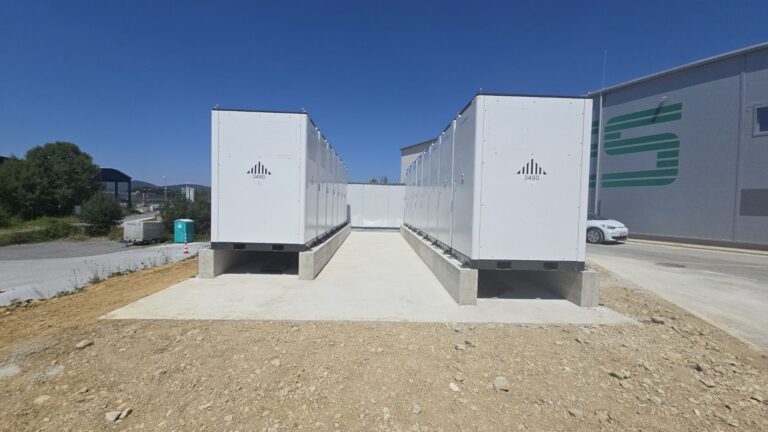
A successful ground-mounted solar power plant project starts with the land and the grid, not with the panels. At JB energija we manage projects from the development phase to grid connection — among other things, we have delivered ground-mounted solar power plants of up to 10 MW and larger projects with storage systems — and we can tell you even before you buy the land whether the site has a realistic route to a connection.
Check your land’s potential: send the plot number and cadastral municipality to info@jb-energija.com or call +386 7 292 7028.
Sources:
- ZUNPEOVE (Official Gazette of the RS No. 78/23; ZUNPEOVE-B amendment, RES acceleration areas): https://pisrs.si; summary: https://www.gov.si/novice/2023-07-07-zakon-o-uvajanju-naprav-za-proizvodnjo-elektricne-energije-iz-obnovljivih-virov-energije/
- Decree on more detailed spatial planning rules for siting photovoltaic installations (2024): https://www.gov.si/novice/2024-04-10-poenostavljeni-in-enotni-pogoji-za-postavitev-soncnih-elektrarn-po-vsej-drzavi/; MNVP questions and answers: https://www.gov.si/assets/ministrstva/MNVP/Dokumenti/Prostorski-red/Zbirka_odgovori_OVE.pdf
- RES studies — MOPE public notices (examples: Tuncovec, Brstje, ZOOP Maribor, Hrastje-Mota): https://www.gov.si/zbirke/javne-objave/
- PV obligation for new buildings/car parks over 1,000 m²: N1, https://n1info.si/novice/slovenija/od-danes-veljajo-nova-pravila-za-vecje-soncne-elektrarne/