
In industry, the network-charge cost is not determined by average consumption but by a few of the highest 15-minute peaks. A press that starts at 6:05, compressors that start up at the same time after the break, an electric furnace on the evening shift — each of these peaks raises the billed capacity, and under the new network-charge billing, exceedances of the contracted capacity are also charged separately. That is why peak shaving with a battery storage system has become one of the investments with the fastest measurable effect.
How the cost arises: capacity, blocks, exceedances
Under the Slovenian Act on the methodology for calculating network charges (Energy Agency), business customers with a connection capacity above 43 kW are charged network charges:
- for the contracted billed capacity (EUR/kW) in each of the time blocks, where the basis is set from past peaks in each block;
- for the energy taken from the grid (EUR/kWh) at the tariff of the block;
- for excess capacity, when the 15-minute average power exceeds the contracted billed capacity, with each exceedance charged according to the formula in the act, using a factor that depends on the block.
So there are three levers for savings: a lower contracted capacity, shifting consumption into cheaper blocks and eliminating exceedances.
How does peak shaving with a storage system work?
An energy management system (EMS) monitors the 15-minute average power of the metering point in real time. As it approaches the set limit, the storage system starts covering part of the load from the battery; once the peak has passed, the battery recharges in a cheap block. Industrial storage systems also perform other tasks: storing surpluses from the company’s own solar power plant, providing backup power for critical loads and, if needed, taking part in ancillary services.
Savings calculation — an illustrative example
Assumptions (clearly marked; they do not constitute a quote):
- a manufacturing company, connection capacity 400 kW, supplied at MV;
- peaks of up to 350 kW occur 2–3 times a week in the morning block, otherwise a typical load of 220–260 kW;
- goal: permanently limit the 15-minute peak to 280 kW and reduce the contracted capacities by 70 kW in the more expensive blocks;
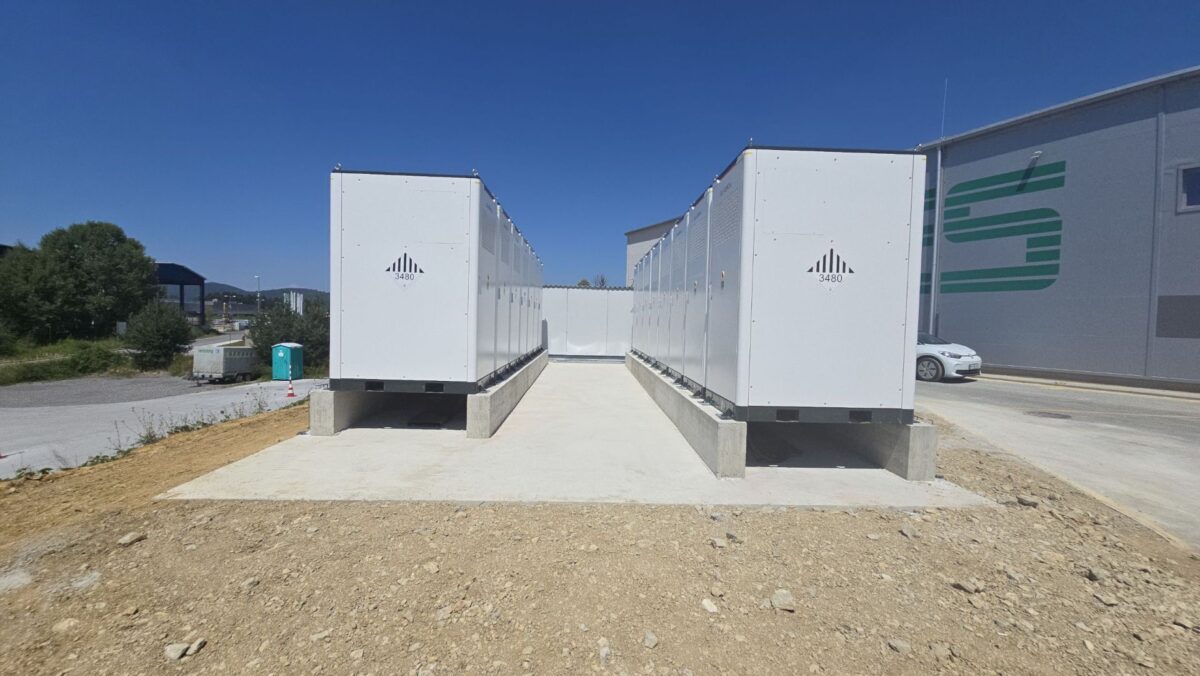
- a 150 kW / 300 kWh storage system with an EMS;
- capacity tariff rates according to the act in force for the relevant user group (MV supply) (we use an indicative range in the calculation; the specific rates are published at uro.si.)
Estimated effect:
- Network charge for capacity: a 70 kW lower contracted capacity in the more expensive blocks brings savings of approximately several thousand to EUR 10,000+ per year, depending on the user group and the blocks in which the peaks occur.
- Excess capacity: eliminating exceedances that were previously charged under the excess formula — for companies with regular exceedances, this is often an amount comparable to or larger than point 1.
- Energy by block: charging in ČB 4/5 and discharging in ČB 1/2 adds a smaller but steady saving.
- Synergy with a solar power plant: if the company has its own power plant, the storage system increases the share of energy used on site and thus also lowers the supply cost.
The actual saving depends entirely on your consumption profile, so without an analysis of 15-minute data, any figure is guesswork.
The process: from data to a working system
- Analysis of 15-minute metering data (mojelektro.si or an export from the operator) for at least 12 months to identify peaks by block and season.
- Peak-shaving simulation: determining the optimal power limit and the power and capacity of the storage system (kW/kWh) — the point at which the marginal saving still covers the marginal cost of the battery.
- Check of connection conditions (approval, space, fire safety, ventilation).
- Installation and EMS setup, including the time-block schedule and protective limits.
- Monitoring and annual optimisation; the contracted capacities can be adjusted once the new peak situation has been confirmed.
Conclusion
At JB energija we have delivered industrial storage systems from a hundred kilowatt-hours to multi-megawatt BESS, and we prepare the simulation based on your real 15-minute data.
Send us an export of your 15-minute data (we can help you get it) at info@jb-energija.com or call +386 7 292 7028, and we will prepare a calculation on your data.
Sources:
- Act on the methodology for calculating network charges for electricity operators (unofficial consolidated text, PISRS): https://pisrs.si/api/datoteke/integracije/574479794 — capacity billing above 43 kW by block, excess capacity (15-min exceedances), excess formula
- Adopted act with amendments (Energy Agency, 10/2025) — monthly notification of exceedances, treatment of storage systems: https://www.agen-rs.si/documents/10926/554036/Sprejeti+akt_20251006/893bdb24-a92b-4596-a044-df93eb81b186
- Borzen — subsidy for storage systems of legal entities, EUR 225/kWh (lot B): https://borzen.si/Portals/0/Feri_Borzen_PPT_OVE_Focus_november_2025.pdf