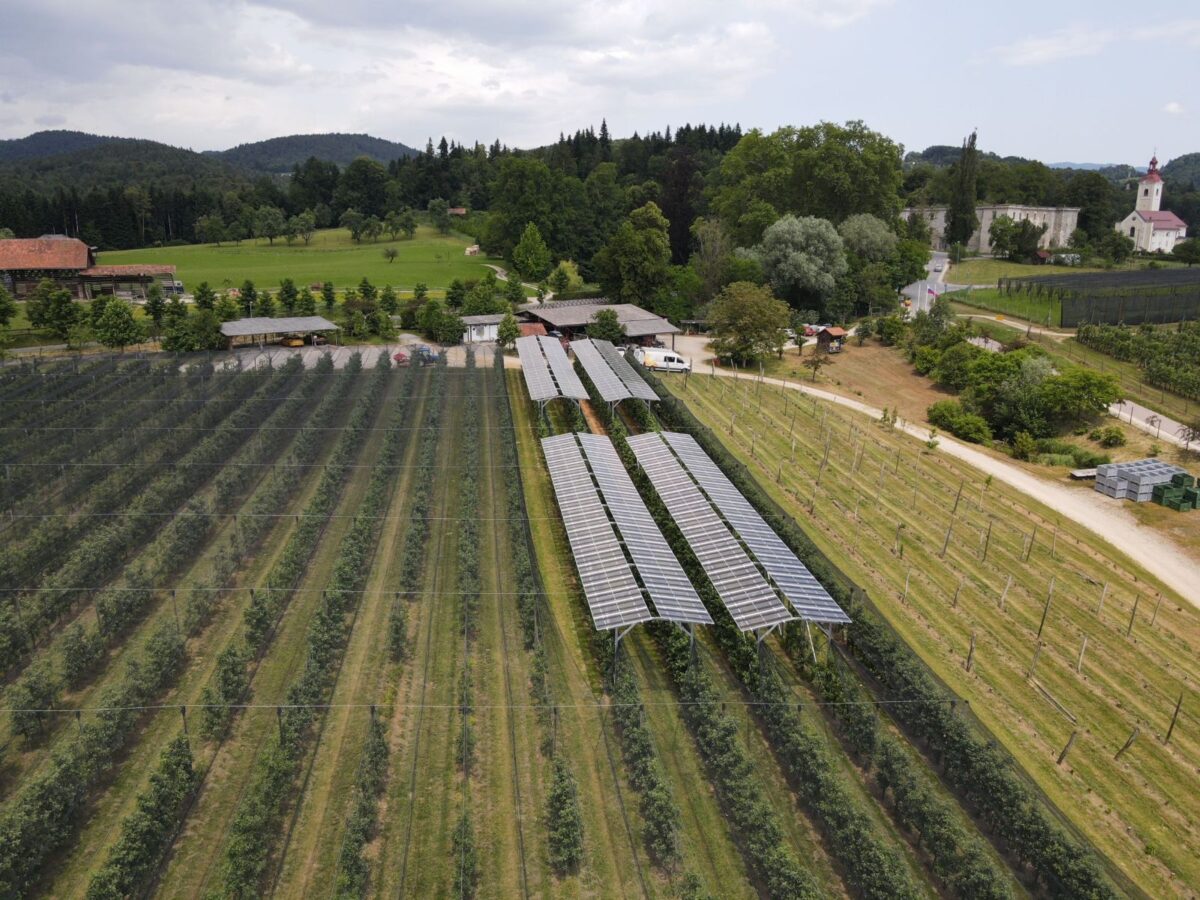
Can the same land produce food and electricity at the same time? Agrivoltaics (AFV) — installing photovoltaic modules above farmland while keeping it in agricultural production — is a fast-growing field in Europe, and in 2025 it had its first serious test in Slovenia: a pilot project in the experimental orchard of the Agricultural Institute of Slovenia at Brdo pri Lukovici. Let us look at what the project actually tests, what the legal framework is and what it means for farms and investors.
What is agrivoltaics?
In agrivoltaics, the modules are mounted on a structure above an orchard or between rows of crops so that agricultural production remains the primary use of the land. Besides generating electricity, the modules can also benefit farming:
- shade during increasingly frequent heatwaves and less water evaporation;
- protection from hail and heavy rain (and partly from frost);
- the possibility for the farm to supply itself with electricity (cooling, irrigation, machinery).
The key trade-off is that the modules intercept some of the light, so the system must be designed so that the crop remains acceptable in both quantity and quality.
The Brdo pri Lukovici pilot project: verified facts
Slovenia’s first agrivoltaics pilot project was presented to the public in July 2025 in the experimental orchard of the Agricultural Institute of Slovenia (Brdo Infrastructure Centre, Brdo pri Lukovici), during a visit by the Minister of the Environment, Climate and Energy and the Minister of Agriculture, Forestry and Food.
Project data:
- Location and crop: the KIS research orchard, an orchard of Kiku apple trees; apples account for the largest share of Slovenian fruit production, so they are a sensible first test crop.
- Technology: 208 bifacial photovoltaic modules above the rows of trees, with different light transmittance in different fields, a total peak capacity of around 52 kW; the test fields cover around 560 m².
- Funding: EUR 205,000 (incl. VAT) from the so-called second Swiss contribution; around EUR 2 million more is expected to be available for similar projects.
- Partners: the Agricultural Institute of Slovenia, the Innovation and Development Institute of the University of Ljubljana, the Ministry of the Environment, Climate and Energy (MOPE) and the Ministry of Agriculture, Forestry and Food (MKGP).
- Purpose: to establish whether, and under what conditions, solar power plants can be installed on selected agricultural land without reducing its agricultural potential; the results will form the basis for further guidelines on the development of agrivoltaics in Slovenia.
The project is a research project, and the long-term results (impact on crop yield, microclimate, economics) will be prepared over the coming years. The first experiences abroad and at home are encouraging, but the final Slovenian figures will only be known after the monitored growing seasons have been completed. Any claims of »proven« agrivoltaic yields in Slovenia are premature at this point.
What does Slovenian legislation say?
- Agrivoltaics is developing at the intersection of energy legislation (ZUNPEOVE) and agricultural legislation (the Slovenian Agricultural Land Act). A systematic framework for agrivoltaics was still taking shape in 2024–2026: the proposed amendments to the Agricultural Land Act (ZKZ) provided for options mainly on agricultural land becoming overgrown and permanent grassland of lower quality, with agricultural use maintained.
- Pilot projects such as the one at Brdo are an exception that is permitted on higher-quality land too, precisely in order to gather data.
- The public debate has mentioned a cap on the reduction in crop yield as a condition (a maximum of 15–20% has been cited), which indicates the direction of future regulation.
What does this mean for farms and investors?
- A farm with electricity consumption (cooling, dairy, irrigation): there are already realistic self-supply options on the roofs of farm buildings today; agrivoltaics above permanent crops will be the next step once the regulation is finalised.
- Fruit growers with anti-hail netting: in the long term, an agrivoltaic structure can replace or complement protective systems — one of the key synergies being tested at Brdo.
- Investors: agrivoltaics is not a shortcut to conventional power plants on agricultural land, as agricultural use remains primary and projects will be assessed by their impact on production.
Having installed the pilot project, we at JB energija are now monitoring the effects and the regulation, and preparing technical solutions for permanent crops and farm buildings. For farms we already build self-supply power plants with storage systems today, and for agrivoltaics we advise on preparing projects that will comply with the upcoming rules.
Conclusion
For Slovenian agrivoltaics, Brdo pri Lukovici is what the first wave of rooftop self-supply power plants was a few years ago: a pilot that will set the rules of the game. Farms that are already thinking about dual land use today will have an advantage once the regulation is adopted.
Thinking about solar energy on your farm? Call +386 7 292 7028 or write to info@jb-energija.com — we will check the options for your roofs and land and let you know when the agrivoltaics rules are final.
Sources:
- MOPE/gov.si, press release »Agrofotovoltaika — priložnost za sinergijo med pridelavo hrane in čisto energijo« (9 July 2025): https://www.gov.si/novice/2025-07-09-agrofotovoltaika-priloznost-za-sinergijo-med-pridelavo-hrane-in-cisto-energijo/
- MKGP/gov.si (9 July 2025): https://www.gov.si/novice/2025-07-09-agrofotovoltaika-je-eden-od-odgovorov-na-vse-vecje-izzive-kmetijstva/
- Agricultural Institute of Slovenia — press release and leaflet on the pilot project (location, Kiku variety, IC Brdo contacts): https://www.kis.si/wp-content/uploads/2025/10/Sporocilo_za_javnost_Agrofotovoltaika_priloznost_za_sinergijo_med_pridelavo_hrane.pdf; https://www.kis.si/wp-content/uploads/2026/06/SLO-zgibanka-AGROFOTOVOLTAIKA_2025_www.pdf
- RTV SLO (52 kW, 208 modules according to summaries; EUR 205,000, Swiss contribution; 560 m² of test fields; expert views): https://www.rtvslo.si/n/751422; https://www.rtvslo.si/okolje/koristi-in-tveganja-soncnih-panelov-na-kmetijskih-zemljiscih/753223
- Technical data (52 kW, 208 bifacial modules): Balkan Green Energy News, https://balkangreenenergynews.com/rs/pilot-projekat-agrosolara-u-sloveniji/