Since 1 October 2024, network charges in Slovenia have been billed under a new methodology with time blocks. The cost of the grid no longer depends only on how much electricity you use, but above all on when you use it and at what power. That is exactly why a battery energy storage system has become one of the most effective tools for keeping the electricity bill under control, both at home and in a business.
What are time blocks and how do they work?
The new methodology is set out in the Slovenian Act on the methodology for calculating network charges for electricity operators (Official Gazette of the RS No. 146/22 et seq.), issued by the Energy Agency on the basis of ZOEE. Its key features:
- Two seasons: the higher season runs from November to February, the lower season from March to October.
- Five time blocks (ČB 1–5): ČB 1 is the most expensive and applies only in the higher season on working days; ČB 5 is the cheapest and applies only in the lower season. Three blocks alternate within each day.
- Separate billing of network charges for power (EUR/kW) and for energy (EUR/kWh): most of the cost is the network charge for the contracted billed capacity in each block.
- Excess capacity: if the 15-minute average power exceeds the contracted billed capacity, the exceedances are charged additionally.
Put simply, the grid is most expensive when it is most heavily loaded, i.e. during the winter morning and evening peaks. Those who know how to shift consumption or cover it from their own source pay less.
A note on the transition to 2027: in October 2025 the Energy Agency adopted amendments to the act under which, from 1 January 2027, the time blocks will be rearranged (only two blocks on non-working days, harmonised transitions, no one-hour morning block), and the way contracted capacities are set will also change. The tariff rate for the most expensive ČB 1 is rising gradually to its target value. Specific tariffs for 2027 will be published at the end of November 2026, so treat the figures in this article as an illustration of the methodology, not as a price list. (check the current tariff rates at www.uro.si)
Three ways a storage system lowers network charges
1. Lower contracted billed capacity (small-scale peak shaving)
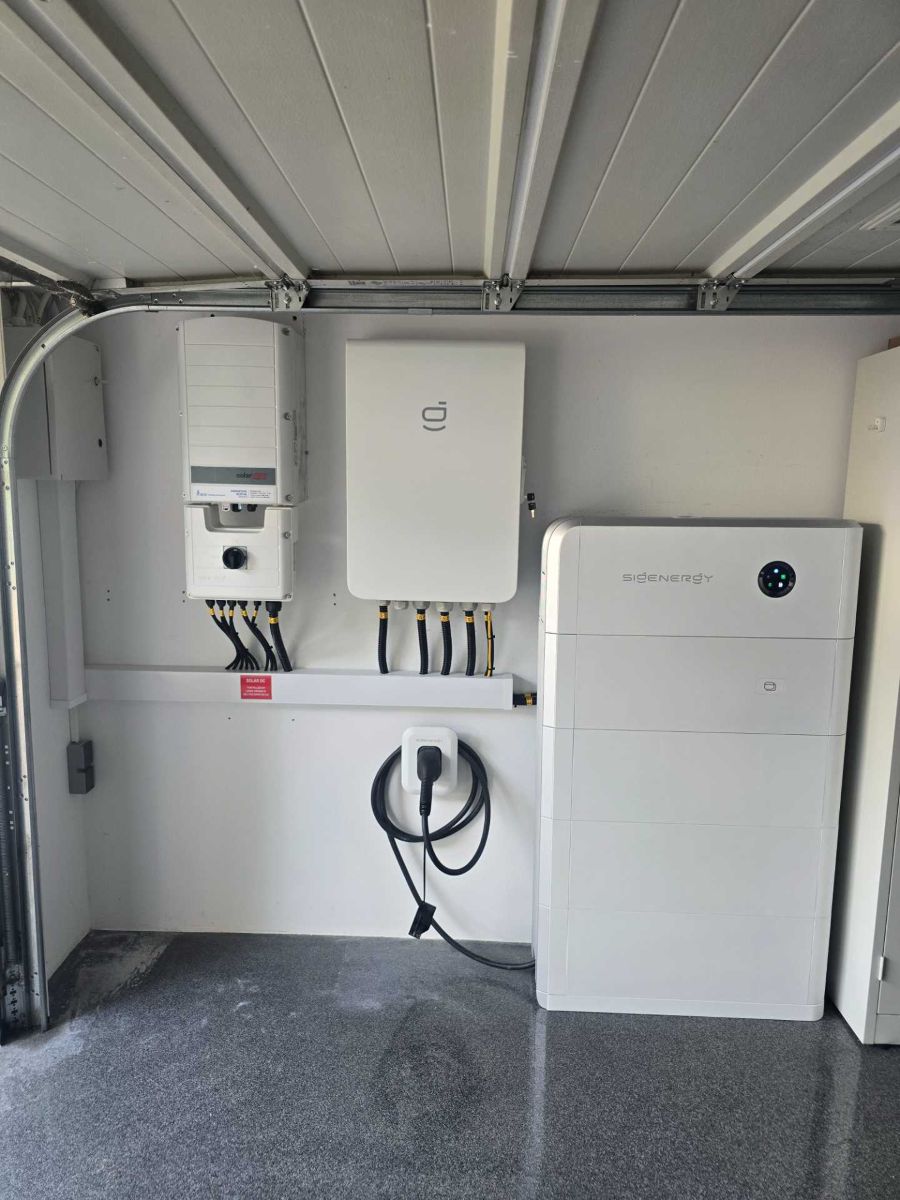
The network charge for power is paid for each kW of contracted capacity in each time block. When larger loads switch on (a heat pump, an induction hob, electric vehicle charging), a hybrid system with a storage system covers part of the power from the battery. Peaks towards the grid are reduced, so you can contract a lower billed capacity, in all blocks and all year round.
2. Avoiding expensive blocks (time-of-use optimisation)
The storage system charges in cheap blocks (at night, at weekends, in summer from the solar power plant) and discharges in expensive ones (the winter morning and evening peaks). A smart controller or energy management system (EMS) does this automatically, following the time-block schedule.
3. Less excess capacity and fewer penalties
Short-term exceedances of the contracted capacity are charged as excess capacity. The storage system acts as a buffer: it smooths the 15-minute power averages and catches exceedances before they occur.
An indicative calculation for a household
Assumptions (an illustrative example, not a quote): a household with a heat pump and an annual consumption of 8,000 kWh; contracted capacity in ČB 1–3 reduced from 7 kW to 5 kW thanks to a 10 kWh storage system; part of the consumption (an estimated 1,500 kWh/year) shifted from more expensive to cheaper blocks; tariff rates according to the act in force for 2026.
- savings on the network charge for power: a 2 kW reduction in three blocks brings approximately EUR 60–120/year at the current tariffs;
- savings on the network charge for energy and on supply: shifting 1,500 kWh into cheaper blocks brings approximately EUR 40–80/year, depending on the supplier’s price list;
- an additional effect that usually dominates: higher self-consumption of the solar power plant (from ~30% to ~70%), which, at an electricity price of around EUR 0.15–0.20/kWh, means another few hundred euros a year.
The overall effect always depends on the consumption profile, which is why we always analyse your 15-minute metering data from the mojelektro.si portal before making a quote. Savings are not guaranteed and differ from building to building.
For businesses: billed capacity is a cost you can manage
For business customers with a connection capacity above 43 kW, the contracted billed capacity is set separately for each time block on the basis of past peaks. An industrial battery storage system controlled by an EMS systematically shaves peaks and thus lowers the basis for billing (we write about this in detail in our blog post on peak shaving in industry). An additional incentive is that, under the ZOEE amendment (ZOEE-A), new larger battery storage systems connected directly to the grid are, under statutory conditions, exempt from network charges for three years from obtaining the occupancy permit, which shows that the legislator explicitly encourages energy storage.
Conclusion
Time blocks have changed the rules of the game: we now pay above all for power and timing, not just for kilowatt-hours. A battery energy storage system is the tool that puts both under your control. At JB energija we have installed storage systems with a total capacity of more than 30,000 kWh, from residential systems to industrial BESS, and we prepare a calculation based on real figures from your metering data.
Book an energy consultation with an analysis of your 15-minute data: +386 7 292 7028 or info@jb-energija.com.
Sources:
- Act on the methodology for calculating network charges for electricity operators, unofficial consolidated text (PISRS): https://pisrs.si/api/datoteke/integracije/574479794
- Act amending the act (Official Gazette of the RS No. 76/25, applicable from 1 January 2026): https://www.uradni-list.si/glasilo-uradni-list-rs/vsebina/2025-01-2723/
- Energy Agency — explanation of the adopted act (6 October 2025, time blocks 2027, gradual increase of ČB 1, storage systems and the ZOEE-A exemption): https://www.agen-rs.si/documents/10926/554036/
- Indicative calculations and tariff rates: uro.si (Energy Agency)
- Seasons and blocks (public summary): RTV SLO, https://www.rtvslo.si/n/668298; Žurnal24, https://www.zurnal24.si/pod-streho/varcna-hisa/vse-kar-morate-vedeti-o-novem-obracunu-omreznine-za-elektriko-415743