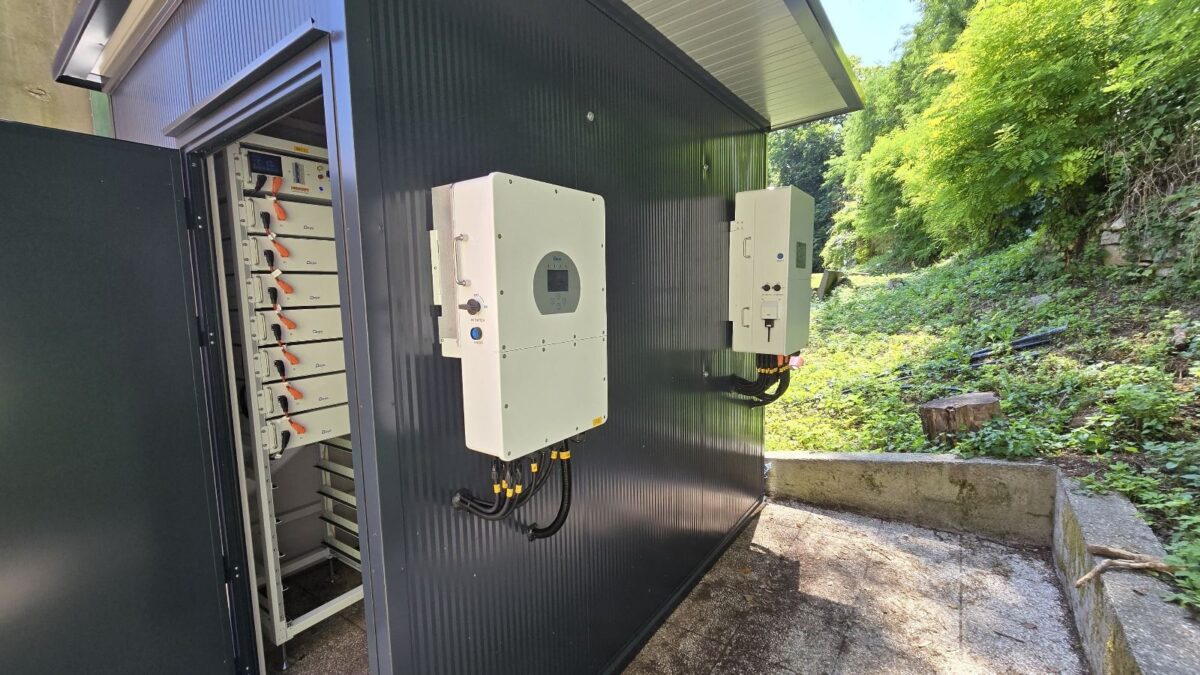
Most Slovenian solar power plants were built without a storage system. With the change in network-charge billing, the end of the old net metering for new systems and increasingly frequent export limitations, the situation has turned around: today a battery energy storage system is often the most sensible upgrade to an existing power plant. In this guide we explain who can add a storage system and under what conditions, what grants are available and how the procedure works.
Can I add a storage system to my power plant?
Technically, adding a storage system is almost always possible; the choice of solution depends on the existing inverter:
- AC-coupled storage system: a battery with its own inverter is connected to the AC side of the installation. The existing power plant remains untouched, which is the most common solution for retrofits.
- DC-coupled / hybrid system: the existing inverter is replaced with a hybrid one, and the battery is connected to it on the DC side. This makes sense when the inverter is nearing the end of its service life or when you want maximum efficiency.
Legal aspect: adding a storage system changes the technical characteristics of the self-supply installation, so before installation the grid connection approval must be amended with the competent electricity distribution company (a change of installation under SONDSEE). We also check whether the change affects your existing billing scheme.
A special case: power plants under the old net metering
Owners of power plants connected under the old Self-Supply Decree (annual net metering) generally keep their scheme when a storage system is added correctly, because the storage system does not increase the capacity of the generating installation but stores your own surpluses. As the rules in this area have changed several times in recent years, we always check the current positions of SODO and your supplier for the specific case before going ahead.
Grants: what does Borzen offer?
The Borzen Support Centre (under ZSROVE, Official Gazette of the RS No. 121/21 et seq.) runs public calls for investments in RES. Two are key for storage systems:
Public call SO-03 — adding a storage system to an existing installation (private individuals)
- EUR 275 per 1 kWh of storage capacity, but no more than 40% of the eligible costs of the investment;
- the storage system must have between 0.7 and 2 kWh of capacity per 1 kW of installed solar power plant capacity (a maximum of 27.2 kWh is subsidised);
- investments carried out from 1 January 2024 onwards are eligible;
- the call is intended for household customers — private individuals without a business activity;
- EUR 8 million was made available.
Worked example: you add a 14 kWh storage system to a 10 kW solar power plant. Subsidy: 14 × 275 = EUR 3,850 (if it does not exceed 40% of the eligible costs). For an investment of around EUR 10,000, this means a reduction of almost 40 percent.
Public call JP-OVE for legal entities
Companies, sole traders and farmers with a registered activity can claim EUR 225/kWh (linked to the installation’s capacity) for an electricity storage system alongside a solar power plant under the calls for legal entities (lot B). The aid is granted under state aid rules; the application must be submitted before work begins or in accordance with the conditions of the specific call.
Important: public calls close when the funds run out, and the amounts and conditions differ from call to call. Before deciding, always check the current call at borzen.si, or leave it to us.
The retrofit procedure — step by step
- Review of the existing system: power plant capacity, inverter type, annual generation and consumption, 15-minute data from mojelektro.si.
- Sizing the storage system: generally 1–2 kWh per kW of power plant capacity, aligned with the subsidy conditions and your consumption profile.
- Amending the grid connection approval with the distribution system operator.
- Installation and commissioning: AC or DC coupling, EMS setup, including settings for the network tariff time blocks.
- Grant application with supporting evidence (invoices, declaration of conformity, photographs, connection certificate).
- Performance monitoring: tracking generation, charging and savings via the app.
The whole procedure, from the review to a working system, usually takes four to eight weeks, depending on how quickly the operator responds and the availability of equipment.
What does a storage system deliver in practice?
- an increase in self-consumption of solar energy from around 30% to 60–80% (depending on the consumption profile — we explain the assumptions with the calculation);
- a lower contracted billed capacity and less excess capacity under the new network-charge billing;
- backup power for selected circuits during a grid outage (if the system is designed for it);
- a solution for limited export: surpluses are stored instead of being curtailed.
No building permit is needed for typical storage systems in residential and commercial buildings, but the grid connection approval must be amended and the system installed by a qualified contractor in line with SONDSEE and the applicable technical regulations.
Modern lithium iron phosphate (LFP) batteries are designed for 6,000 or more charging cycles, or 10–15 years of operation, and manufacturers usually guarantee that around 70–80% of the capacity is retained after 10 years. We check the warranty terms of the specific manufacturer.
Conclusion
Retrofitting a storage system is today the fastest way to get an existing solar power plant working at full value for your own self-supply again, rather than for the grid. At JB energija we carry out the entire procedure on a turnkey basis: from analysis and sizing through the amended approval to installation and the grant application.
Find out how much subsidy you can get: send us your latest electricity bill and details of your power plant at info@jb-energija.com or call +386 7 292 7028.
Sources:
- Borzen, public calls SO-01/SO-02/SO-03 and calls for legal entities (presentations by the RES Contact Point, R. Feri, 2025): https://borzen.si/Portals/0/Točka OVE/gradiva_za_svetovalce/Aktualni razpisi Borzena iz področja OVE za pravne in fizične osebe_Robert Feri.pdf (SO-03: EUR 275/kWh, up to 40%, 0.7–2 kWh/kW, max. 27.2 kWh, investments from 1 January 2024; legal entities: EUR 225/kWh); https://borzen.si/Portals/0/Feri_Borzen_PPT_OVE_Focus_november_2025.pdf (SO-01 closed on 31 December 2025, available funds)
- ZSROVE — Act on the Promotion of the Use of Renewable Energy Sources (Official Gazette of the RS No. 121/21): https://pisrs.si
- Restriction of call SO-03 to household customers: Žurnal24, https://www.zurnal24.si/pod-streho/varcna-hisa/novo-subvencije-za-baterijske-hranilnike-a-le-za-nekatere-429897
- SONDSEE (change of installation, approval): SODO, https://www.sodo.si